05 June 2026
In focus

Weak US data lifts Pound as economic concerns deepen
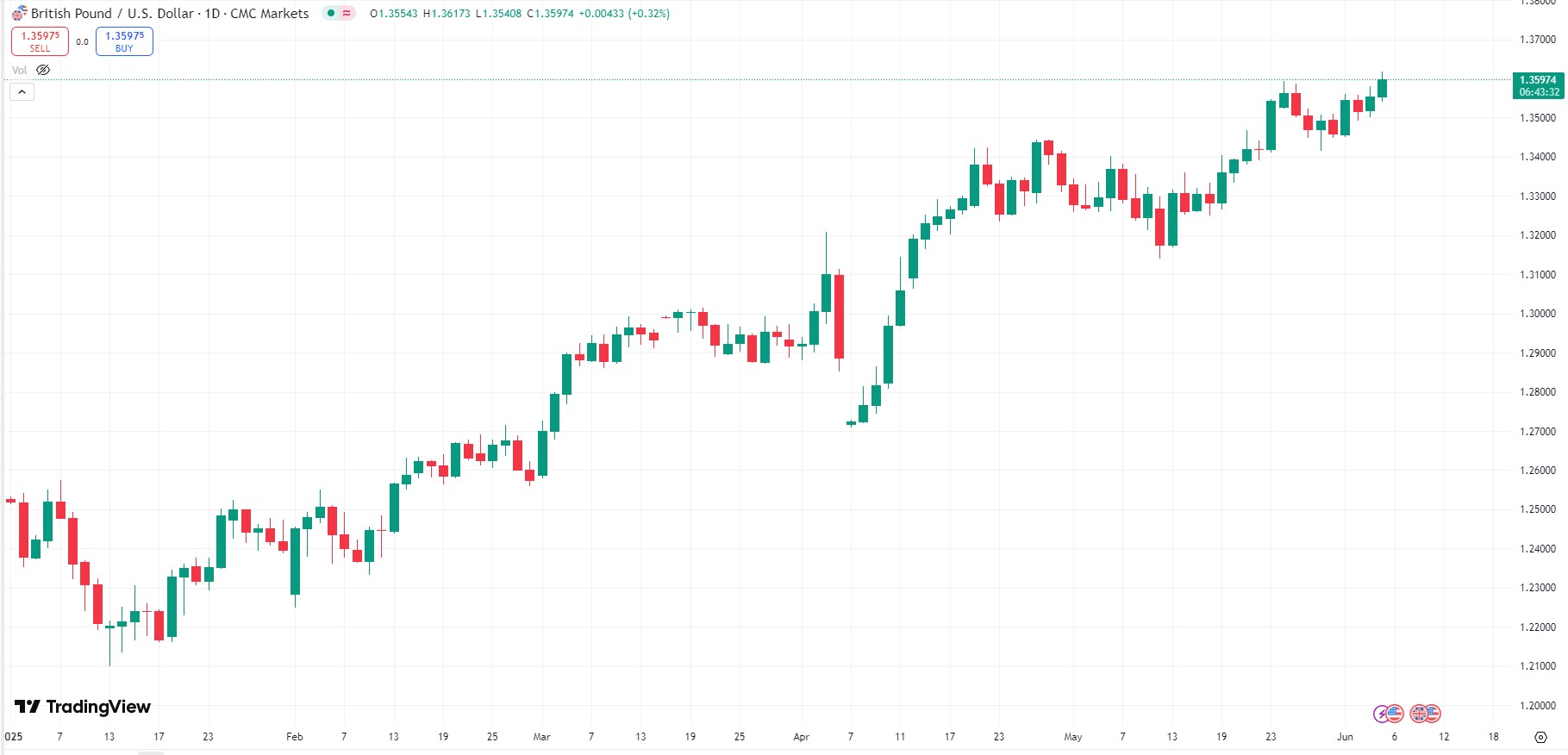
Fresh figures from the United States suggest the economy is showing signs of stagnation paired with persistent inflation—a combination that economists refer to as stagflation. In response, the Pound strengthened against the Dollar, with the GBP/USD rate climbing to an interbank high of 1.3610 on Thursday.
This came after a weaker-than-expected update from the Institute for Supply Management (ISM), whose services PMI dropped to 49.9 in May, down from the previous reading by 1.7 points. The figure came in well below forecasts of 52.0 and indicates a slowdown, as any reading under 50 suggests contraction in the sector.
The slowdown appears to be driven largely by a marked decline in new business and flatlining activity—likely linked to prolonged trade-related challenges. At the same time, the report's measure of prices paid continued to rise, suggesting inflationary pressures remain firmly in place. This presents a dilemma for the Federal Reserve, as rising prices make it more difficult to justify interest rate cuts, even as the broader economy loses momentum.
Compounding concerns was a separate employment update released on Thursday. The ADP private payrolls report showed just 37,000 jobs were added in May—the weakest result in more than two years and well below the 115,000 anticipated by analysts.
All eyes now turn to Friday's official labour market report. Should that data also disappoint, the Dollar may weaken further, potentially pushing GBP/USD to fresh highs for the year.
Euro strengthens as ECB signals rate cuts may be nearing an end
The euro gained ground following fresh comments from the European Central Bank, which hinted that its cycle of interest rate reductions could soon draw to a close.
President Christine Lagarde announced on Thursday that the ECB had cut its key policy rate by 25 basis points to 2.0%. However, she also suggested this could be one of the final moves in the current easing phase, indicating that borrowing costs may now be appropriately aligned with the economic outlook.
“We are in a good place,” said Lagarde, implying little urgency for further action. Her remarks have cast doubt on expectations for additional reductions, with some economists now questioning whether a further cut to 1.75% is still likely.
The euro showed resilience in the face of the actual rate cut, as markets appeared more focused on the ECB's downgraded forecasts for inflation and growth. Yet it was Lagarde’s press conference that appeared to shift sentiment more decisively. Investors responded by adjusting their expectations, with money markets now anticipating no more than one further cut before the end of the year.
As a result, the euro-to-dollar exchange rate rose to 1.1476, edging closer to the 1.15 mark. The euro also moved higher against the pound, recording a daily increase of 0.13% and reaching 0.8436, while the pound-to-euro rate slipped to 1.1852.
In a noteworthy aside, one member of the ECB’s Governing Council expressed a differing view—though details remain limited for now.