

03 June 2026
News

Market overview
Japan has delivered a striking reminder that it is willing to lean against yen weakness, but the market message remains clear: intervention alone is unlikely to reverse the USD/JPY trend.
The Ministry of Finance has confirmed that the Bank of Japan sold JPY11.735tr, or roughly $74bn, between 28 April and 27 May. That makes this the largest quarterly intervention since 2004. The scale is notable, but the backdrop is still doing the heavy lifting. Unless oil prices or US yields move sharply lower, USD/JPY is likely to remain well supported.
FX intervention: A large line in the sand
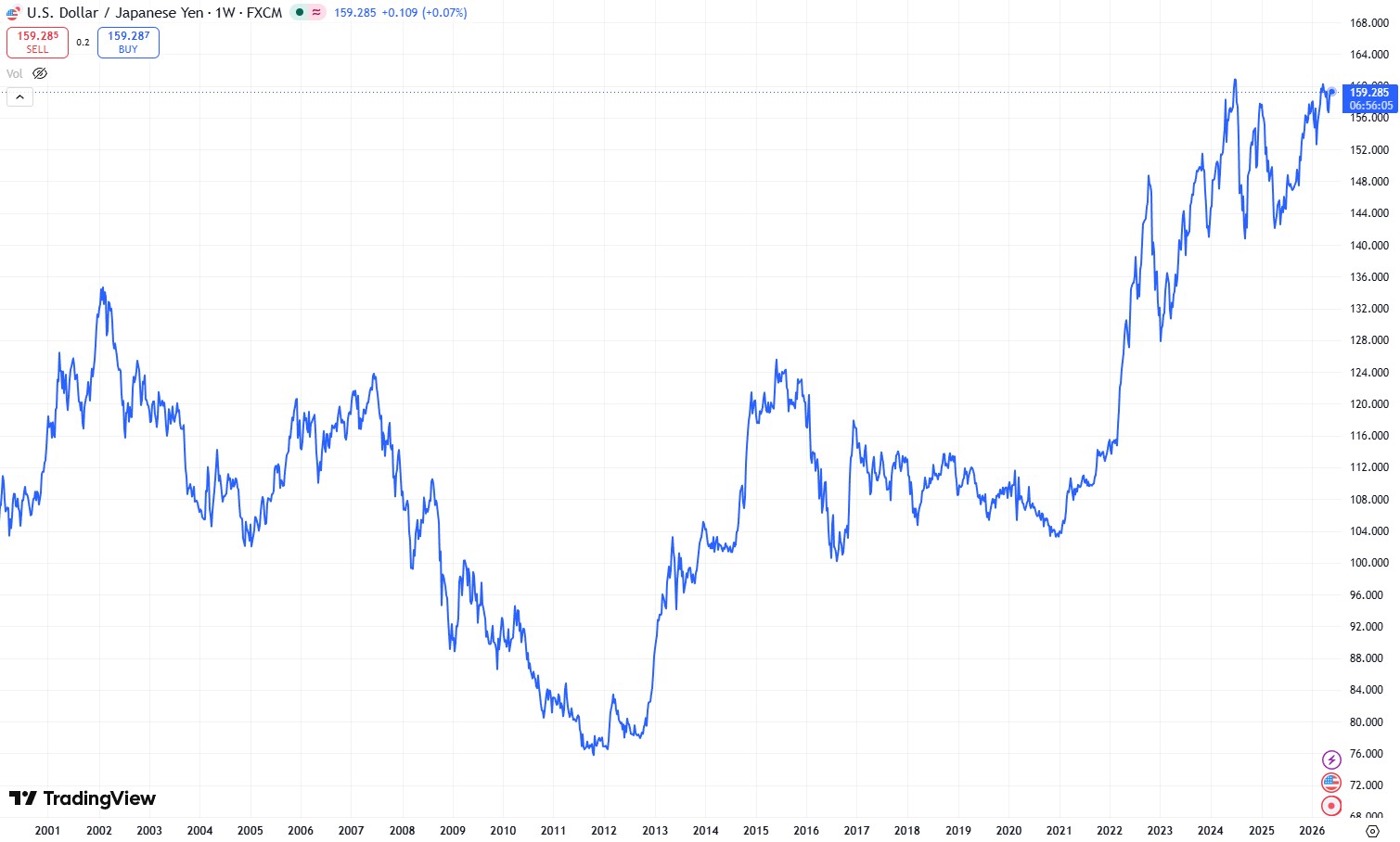
The latest figures confirm sizeable official action in late April and May. The first round was most likely on 30 April, when USD/JPY was pushed from above 160 to below 156, with further activity seemingly following over the next four trading sessions.
The numbers are substantial by historical standards. To find quarterly intervention on this scale, investors have to look back to early 2004, when Japan was acting almost daily to hold USD/JPY above 100 during a broad dollar bear market. At that point, the Federal Reserve had already cut rates to 1.00% after the dot-com downturn.
Since then, Japanese FX operations have generally been smaller and less frequent. There is also market speculation that officials may be mindful of the IMF’s FX regime classifications. Repeated intervention, particularly beyond three instances in six months, could risk Japan being reclassified from a “free floating” to a “floating” regime, putting it closer to markets such as Brazil and Chile than to its G7 peers.
USD/JPY: Intervention is not changing the trend
With USD/JPY already back near 160, it is difficult to argue that this year’s intervention has had a lasting impact. The contrast with 2024 is important. Then, the market was heavily short yen and US rates were falling ahead of the Fed’s easing cycle, giving intervention a more supportive macro backdrop.
That is not the case now. Speculative yen shorts are less stretched, while the Fed is moving closer to a hawkish bias than a dovish pivot. That leaves Japanese officials fighting the underlying rate differential, rather than reinforcing it.
The risk is that the BoJ is forced back into the market if USD/JPY breaks above 160 again. This also matters for US Treasuries, as Japan appears to have funded FX operations through Treasury sales. Japanese holdings fell by roughly $100bn in 2024, broadly in line with that year’s intervention totals.
Japan still has large FX reserves of more than $1tr, but intervention capacity is not unlimited. Officials are unlikely to be comfortable running those reserves down by 20% to 30% simply to slow, rather than reverse, yen weakness.
Looking ahead: Yen relief needs more than intervention
- A BoJ rate rise on 16 June remains our base case, with markets now pricing around a 78% probability.
- The bar for a yen-positive outcome is high. A hike alone may not be enough unless it comes with a clearly hawkish policy signal.
- To shift USD/JPY meaningfully lower, the BoJ would likely need to guide markets towards a policy rate above 1.50% next year, from 0.75% today.
- That may be difficult in the current political environment, particularly if policymakers want to avoid tightening financial conditions too aggressively.
- In the near term, USD/JPY looks likely to stay bid around 160, with scope for a move into the 162 to 163 area.
- A year-end move towards 155 still depends on weaker US consumption and the Fed reopening the door to rate cuts.
- For now, the market focus is firmly on rising Fed hawkishness, which leaves the yen vulnerable despite Japan’s latest show of force.