

03 June 2026
News

Ranges and a clear pivot in sentiment
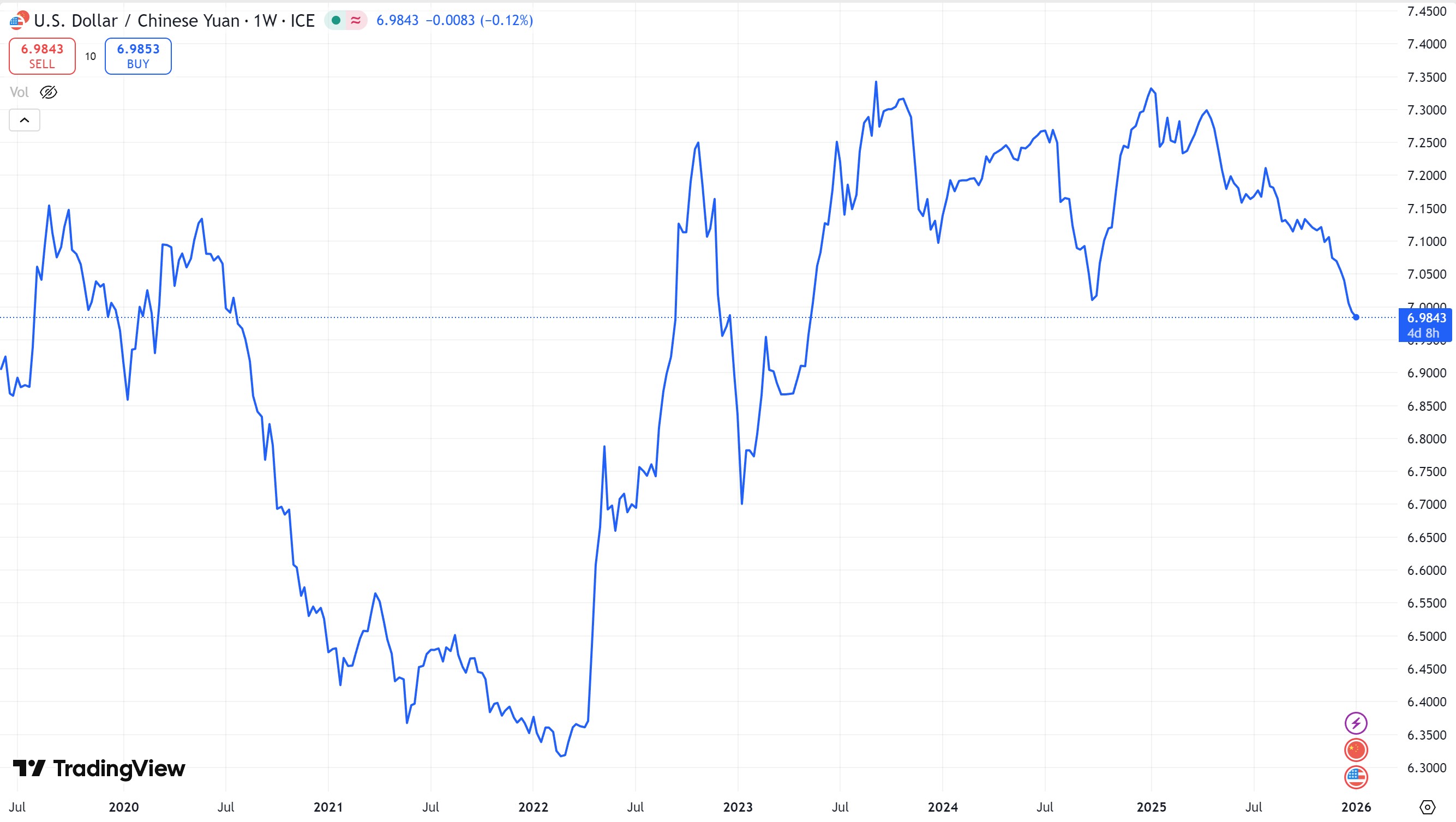
USDCNY stayed largely contained through 2025, with a 7.00 to 7.40 fluctuation band proving broadly consistent with realised moves for most of the year. Spot briefly slipped below 7.00 on the penultimate trading day of 2025, while the full-year range printed at roughly 6.99 to 7.35; USDCNH was marginally wider at around 6.98 to 7.42. The narrative rotated sharply over the year, from early focus on depreciation risk linked to trade frictions, to late-year discussion around how much CNY appreciation could support imports and consumption.
PBoC: stability framework, now focused on speed of gains
Policy continues to lean towards currency stability, historically expressed via resistance to rapid depreciation. Recent signals suggest the same framework is being applied to the upside. Since early December, the countercyclical factor has been negative, implying fixings have been set to dampen the pace of appreciation. The key near-term question is how much appreciation is tolerated; current evidence points to only limited pushback versus the stronger resistance seen during prior depreciation episodes.
Rates: narrowing differentials remain supportive
US-China yield spreads compressed through 2025. The 2-year spread narrowed from about 3.14pp at the start of the year to roughly 2.10pp by year-end, while the 10-year spread moved from around 2.89pp to approximately 2.31pp. The next leg is likely to be driven by shifts in policy expectations; consensus entering 2026 was broadly consistent with around 50bp of Fed cuts and roughly 20bp of PBoC cuts. Further narrowing looks plausible, but a repeat of 2025’s pace is less likely.
Flows and positioning: trade surplus support, hedges shifting
A relatively steady USDCNY profile meant CNY’s moves versus other currencies often mirrored the USD’s broader direction. EURCNY, for instance, tracked the EURUSD path closely and traded in a wide 7.40 to 8.45 range, with CNY weakness versus EUR potentially supportive for EU-bound exports. More recently, a stable USD backdrop alongside firmer CNY has lifted trade-weighted measures; the CFETS RMB Index and BIS China REER Index recovered around 2.6 to 2.7% from mid-2025 lows. In derivatives, NDF points versus spot were generally negative since mid-2022, consistent with hedging against appreciation; those points have moved higher as spot strengthened, with 1-month NDF points turning positive in late December for the first sustained period since 2022 outside brief holiday distortions. Externally, the trade surplus continued to expand despite trade-war dynamics, eclipsing USD 1tr by November and likely ending the year more than 20% higher than 2024. That backdrop raises the probability of episodic conversion waves if appreciation momentum strengthens and rate differentials compress further.
Looking ahead
-
Bias remains towards a stronger CNY narrative into 2026, with markets focused on potential appreciation as a lever to support imports and consumption.
-
The main swing factor is the PBoC’s tolerance for the pace of gains; current signals suggest gradualism is preferred, rather than a hard cap.
-
A reasonable 2026 working range looks lower than last year’s, with an expected USDCNY fluctuation band of 6.85 to 7.25, assuming no sharp deterioration in risk sentiment or policy surprise.