
Seven days, three central banks: why September could be pivotal for FX
September is shaping up to be one of the most important periods of the year for currency markets.
Within just seven days, the European Central Bank, Federal Reserve and Bank of England will all make interest-rate decisions, creating a concentrated period of event risk for the euro, US dollar and pound.
The ECB goes first on 10 September, followed by the Federal Reserve on 15/16 September, before the Bank of England completes the sequence on 17 September.
All three face different challenges. The ECB is dealing with renewed inflation pressure, the Fed remains divided over whether further tightening is needed, while the BoE must balance persistent UK inflation against a softer domestic backdrop.
For businesses with international currency exposure, that could mean increased volatility across GBP/EUR, GBP/USD and EUR/USD.
FX market snapshot
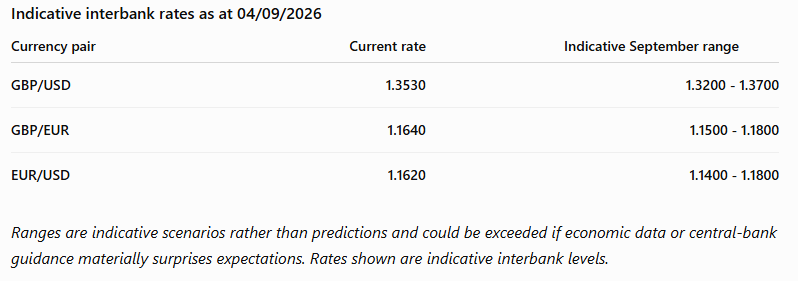
Indicative interbank rates as at 04/09/2026
ECB: has inflation changed the equation?
10 September
The ECB will be the first major central bank to decide.
Euro-area inflation accelerated to 3.3% in August from 2.9% in July, increasing pressure on policymakers and strengthening expectations of another rate increase.
A 25 basis point hike is widely expected, which means the bigger question may be what the ECB signals about the months ahead.
If policymakers suggest further tightening could follow, European yields may rise and the euro could strengthen. If the ECB hikes but takes a more cautious tone on future policy, some of the euro's recent support could fade.
Indicative September range: 1.1500 - 1.1800
Strong levels remain available, but ECB risks are building
Sterling remains at attractive levels against the euro, although GBP/EUR has pulled back from above 1.18 earlier in the summer.
A more hawkish ECB could narrow sterling's interest-rate advantage and push GBP/EUR towards 1.15, increasing the sterling cost of future euro payments.
Conversely, if the ECB delivers the expected hike but suggests further tightening is unlikely, while the BoE remains relatively hawkish, the pair could move back towards 1.17 to 1.18.
For businesses with EUR requirements, the ECB meeting therefore presents a clear event risk while relatively strong exchange rates remain available.
Federal Reserve: one of the closest calls of the year
15-16 September
Attention then turns to the Federal Reserve, where the decision appears far less certain.
Rates were held at 3.50% to 3.75% in July, but three policymakers voted for an immediate 25 basis point increase.
The Fed now faces a finely balanced decision. August payrolls surprised sharply to the upside, strengthening the case for further tightening, while inflation remains above target. Attention now turns to US CPI on 11 September, which could prove decisive.
US CPI is released on 11 September, just five days before the decision, and could materially change market expectations.
The September meeting also includes updated economic forecasts and the Fed's closely watched interest-rate projections. Markets will therefore be focused not only on what happens on 16 September, but what policymakers signal for the remainder of the year.
Indicative September range: 1.3200 - 1.3700
Fed decision could set the next direction
GBP/USD benefited from a softer dollar through much of August, but September could bring a very different backdrop.
A Fed hike, particularly if accompanied by hawkish guidance, could restore support for the dollar and bring the 1.32 to 1.33 area back into focus.
A softer inflation reading followed by a Fed hold could have the opposite effect, allowing sterling to challenge 1.36 and potentially 1.37.
For businesses with USD liabilities, the key risk is not simply whether the Fed hikes, but how quickly markets reassess the wider path for US interest rates.
Bank of England: inflation arrives at the last minute
17 September
The Bank of England completes the sequence on 17 September.
Bank Rate currently stands at 3.75%, with the July meeting producing a 6-3 vote to keep rates unchanged. Three members preferred an immediate increase to 4.00%.
The Bank faces a familiar problem. UK growth and parts of the labour market have softened, but inflation remains above target.
Adding to the uncertainty, August UK inflation figures are released on 16 September, just one day before the BoE decision.
A stronger-than-expected reading could increase speculation that more policymakers will support a hike. A softer figure would reinforce the case for keeping rates unchanged.
For sterling, the vote split could be almost as important as the headline decision. A move towards 5-4 would send a much more hawkish signal than another comfortable majority for unchanged rates.
EUR/USD: caught between the ECB and the Fed
Current rate: 1.1620
Indicative September range: 1.1400 - 1.1800
EUR/USD sits directly between two of September's biggest central-bank decisions.
If the ECB raises rates and signals further tightening while the Fed remains on hold, the relative interest-rate outlook could move further in the euro's favour, supporting a move towards 1.17 to 1.18.
The reverse scenario is equally important. A cautious ECB followed by a Fed hike or strongly hawkish message could quickly shift momentum back towards the dollar and bring the 1.14 to 1.15 area into focus.
For businesses exposed to both currencies, September could therefore produce a meaningful change in the relative outlook for the euro and US dollar.
Key dates for the diary
10 September | ECB
Rate decision and guidance on whether further tightening could follow.
11 September | US CPI
Potentially the most important release ahead of the Fed meeting.
15-16 September | Federal Reserve
Rate decision, updated forecasts and interest-rate projections.
16 September | UK CPI
Released just one day before the BoE decision.
17 September | Bank of England
Rate decision, with particular focus on the MPC vote split.
What does it mean for businesses?
Central bank meetings do not move currencies simply because interest rates change. What often matters more is the difference between what happens and what markets expected.
An expected ECB hike may generate little reaction if it is already fully priced. A change in guidance about what comes next could matter far more.
The same applies to the BoE. Rates could remain unchanged, but a shift in the vote could still move sterling. For the Fed, a single inflation reading could change expectations for both September and the remainder of the year.
For businesses with known currency requirements, this concentration of event risk makes the period before the meetings particularly important.
Those with EUR costs face the risk of a stronger euro if the ECB remains hawkish. Businesses with USD liabilities face uncertainty around the Fed and the possibility of renewed dollar strength. Those receiving EUR or USD may benefit from moves in the opposite direction, but remain exposed to sharp reversals.
The objective does not have to be predicting which central bank moves next. It is ensuring that an unexpected decision does not have an outsized impact on margins, cash flow or future payments.
September could reset the FX landscape
The seven days between 10 and 17 September could materially change the outlook for sterling, the euro and the US dollar.
For GBP/EUR, the focus is on whether sterling can maintain its interest-rate advantage. For GBP/USD, the Fed could determine whether recent dollar weakness extends or reverses. For EUR/USD, September represents a direct contest between two central banks whose policy paths may begin moving in different directions.
For businesses with currency exposure, waiting until all three decisions have passed may provide greater clarity. However, by then, FX markets may already have reacted.