
Autumn Budget 2026 FX Special
MONFOR | FX MARKET INSIGHTS
16 October 2026 | Special Pre-Budget Report
The big picture: Three economies, three challenges, one increasingly unpredictable currency market
With the UK Autumn Budget scheduled for 28 October, sterling faces one of its most consequential periods of the year.
For Chancellor John Healey, the challenge is to restore confidence in the public finances while protecting the UK's economic recovery. Across the Atlantic, unexpectedly persistent US inflation is complicating the Federal Reserve's interest rate decisions. Meanwhile, France's mounting debt burden and political uncertainty are creating fresh pressure on the euro.
Together, these developments have created an unusual currency environment in which sterling could strengthen against the euro while simultaneously facing pressure against the dollar.
Yet the pound has demonstrated surprising resilience. As of 16 October, GBP/USD is trading around 1.3333, while GBP/EUR stands near 1.1860, both above their levels when we first examined the Budget outlook on 8 October.
The central question is no longer simply whether the Budget will weaken sterling. It is whether the pound can sustain its recent strength as fiscal credibility, inflation and monetary policy converge.
1. The UK Budget: A test of fiscal credibility
The Chancellor will deliver his first Budget on Wednesday 28 October, accompanied by the Office for Budget Responsibility's updated economic and fiscal forecasts.
The economic challenge is substantial.
According to analysis published by EY on 5 October, the government's estimated fiscal headroom has fallen from £23.6 billion in March to approximately £11.3 billion. This is an independent estimate, rather than a new official OBR forecast.
Higher borrowing costs, inflation and energy-market disruption have all placed additional strain on the Treasury's finances.
Official figures underline those pressures. Public borrowing in the financial year to August reached £77.3 billion, approximately £8.1 billion above the OBR's forecast, while public debt stood at 93.8% of GDP.
Long-dated government borrowing costs have also risen sharply. The 30-year gilt yield briefly exceeded 6% earlier this month, intensifying concerns about the UK's debt-servicing costs.
For currency markets, the implications are significant.
Traditionally, higher government bond yields can support a currency by offering investors improved returns. However, when yields rise because investors perceive growing fiscal risks, the opposite can occur.
Sterling could weaken alongside rising gilt yields if investors begin questioning the sustainability of UK borrowing.
The Chancellor is expected to consider additional revenue-raising measures, including potential changes to the taxation of banks. A rise in the bank corporation tax surcharge has featured prominently in pre-Budget reporting, although no final decision has been announced.
Investors will be watching whether the overall package provides sufficient fiscal headroom, relies on credible economic assumptions and protects the conditions for longer-term investment.
A Budget that reassures gilt investors could provide sterling with support. Conversely, weaker-than-expected OBR forecasts or concerns over the credibility of spending and revenue plans could trigger renewed selling pressure.
2. A stronger UK economy changes the picture
Despite the fiscal challenges, recent economic data offer grounds for greater confidence in the UK economy than earlier in the autumn.
Figures released by the Office for National Statistics on 15 October showed that GDP grew by 0.1% in August, while the economy expanded by 0.7% over the three months to August.
The International Monetary Fund has also upgraded its 2026 UK growth forecast to 1.3%, reflecting stronger activity in the first half of the year, including growth associated with technology and artificial intelligence.
This resilience matters for sterling.
A stronger economy can improve tax revenues, support investor confidence and provide the Bank of England with greater flexibility to address inflation.
At its September meeting, the Bank of England held Bank Rate at 3.75%, although three of its nine Monetary Policy Committee members voted for an increase to 4%.
UK CPI inflation remains elevated at 3.1%, and higher energy costs could create further upward pressure.
Markets are now considering the possibility of a rate increase at the Bank's next meeting on 5 November.
Higher UK interest rate expectations could support sterling, particularly against the euro, although that support would be less reliable if monetary tightening begins to undermine economic activity.
Our assessment: The UK's stronger growth figures provide sterling with a degree of support heading into the Budget. However, the strength of the recovery will only help the currency if investors remain confident in the government's fiscal trajectory.
3. US inflation: A new challenge for GBP/USD
Across the Atlantic, the latest US inflation figures have added another layer of uncertainty.
Data released on 14 October showed that annual US consumer price inflation accelerated to 3.7% in September, up from 3.4% in August.
Core inflation, which excludes food and energy, rose from 2.4% to 2.6%, while headline prices increased by 0.6% over the month.
Further evidence of inflationary pressure emerged the following day, when US producer prices increased by 1.3% in September, taking the annual rate to 6.3%.
Energy prices have been a major contributor, reflecting the continuing disruption associated with conflict in the Middle East.
These developments complicate the Federal Reserve's attempts to bring inflation sustainably back towards its 2% target.
The Fed increased its target interest rate range to 3.75–4.00% in September, and further tightening remains a possibility.
Ordinarily, persistent inflation and expectations of higher US interest rates could strengthen the dollar, creating downward pressure on GBP/USD.
However, the immediate market reaction has been more nuanced.
Despite the inflation surprise, expectations for an October Federal Reserve rate increase have eased following comments from Fed Chair Kevin Warsh indicating that policymakers are not committed to an immediate move.
Sterling has consequently recovered against the dollar, reaching a three-week high on 16 October.
This highlights an important distinction: stronger inflation does not automatically translate into a stronger currency. Exchange rates respond to changes in interest rate expectations, real yields, economic confidence and investors' appetite for risk.
The outlook for GBP/USD will therefore depend on whether the Federal Reserve ultimately needs to pursue a more restrictive policy than markets currently anticipate.
4. France: Could Europe's fiscal problems support GBP/EUR?
While the UK's public finances are attracting scrutiny, fiscal uncertainty is also building within the eurozone's second-largest economy.
France faces a challenging combination of high government debt, rising borrowing costs and political uncertainty ahead of the 2027 presidential election.
French public debt is approaching 120% of GDP, while the government's projected budget deficit for 2026 stands at approximately 5.4% of GDP.
The government has proposed a substantial fiscal adjustment for 2027, involving approximately €54 billion of measures and savings intended to reduce the deficit towards 5% of GDP.
Securing parliamentary support remains difficult.
Financial markets have responded by demanding higher yields on French government debt.
French 10-year bond yields have approached 4.9%, while the spread over equivalent German government bonds has moved towards 140 basis points.
This widening spread reflects the additional compensation investors require to hold French sovereign debt.
For the euro, the main concern is whether prolonged fiscal and political uncertainty begins undermining confidence beyond French bond markets.
France's sovereign credit rating is also due for review by Moody's on 23 October, potentially creating another significant market event immediately before the UK Budget.
For GBP/EUR, this creates an important counterbalance.
Even if the UK faces its own fiscal challenges, continued pressure on French assets could restrict euro strength and provide relative support for sterling.
However, the eurozone is considerably larger than France alone. A country-specific bond sell-off does not necessarily translate into sustained euro weakness, particularly if contagion remains limited.
The European Central Bank also increased its deposit rate to 2.50% in September, and a more restrictive ECB policy could support the single currency.
Our assessment: French political and fiscal uncertainty presents a potential source of support for GBP/EUR, but the strength of that support will depend on developments across the wider eurozone and the relative direction of UK and ECB interest rates.
5. GBP/USD and GBP/EUR: Our updated forecasts
The latest developments have made the currency outlook more balanced than our initial analysis suggested.
Stronger UK economic data and sterling's recent resilience provide some support for the pound. However, US inflation, UK fiscal uncertainty and global market volatility create substantial downside risks.
We have therefore updated our scenario ranges to reflect the changing environment.
Indicative year-end 2026 forecasts
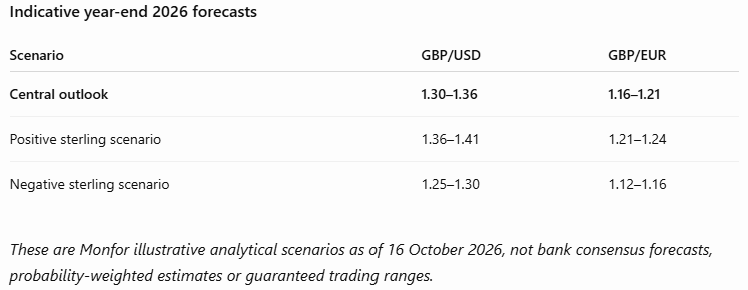
Central outlook: Relative stability, with elevated volatility
Our central expectation is that sterling remains supported by resilient UK economic activity, while volatility increases around the Budget and forthcoming monetary policy announcements.
A fiscally credible Budget could help stabilise gilt markets. However, continued US inflation pressure may limit the scope for a sustained GBP/USD rally.
French fiscal uncertainty could offer some relative support to GBP/EUR, particularly if confidence in the UK's own fiscal position holds up.
Positive sterling scenario: Confidence returns
A credible UK fiscal package, improving gilt market conditions and continued resilience in domestic growth could encourage renewed sterling demand.
If the dollar also weakens as the Federal Reserve maintains a measured approach to further rate increases, GBP/USD could challenge 1.36–1.41.
For GBP/EUR, a combination of stabilising UK borrowing costs and continued French fiscal uncertainty could open the door towards 1.21–1.24.
Negative sterling scenario: Confidence deteriorates
A disappointing Budget, weaker OBR projections or a renewed increase in the UK's fiscal risk premium could undermine the pound.
Against the dollar, additional Fed tightening or stronger global demand for safe-haven assets could compound the pressure.
Under this scenario, GBP/USD could retreat towards 1.25–1.30, while GBP/EUR could fall towards 1.12–1.16 if UK-specific risks outweigh pressures on the euro.
These scenarios are illustrative year-end outcomes. Actual exchange rates may move outside the indicated ranges, including during short-lived periods of heightened volatility.
6. Why this matters for UK businesses
For businesses importing goods, purchasing overseas services or making international payments, currency volatility can have a direct impact on profitability.
Consider a UK company with a $1 million supplier payment.
At an indicative GBP/USD rate of 1.3333, the sterling cost would be approximately £750,000.
If the exchange rate weakened to 1.28, the same payment would cost approximately £781,250 — an additional £31,250.
The impact is similar for businesses purchasing euros.
At GBP/EUR 1.1860, a €1 million payment costs approximately £843,000. At 1.15, the cost increases to approximately £870,000, representing an additional expense of around £27,000.
These examples exclude provider margins, fees and execution costs, but demonstrate how relatively modest currency movements can materially influence business costs.
For companies with known foreign-currency requirements, the current environment reinforces the value of planning ahead.
Forward contracts may offer greater certainty over future exchange costs, while staged conversions can reduce reliance on achieving a favourable exchange rate on one particular day.
The appropriate approach will depend on each business's requirements, cash flow and tolerance for currency risk.
7. The dates that could move sterling next
The final two weeks of October contain several important catalysts for currency markets.
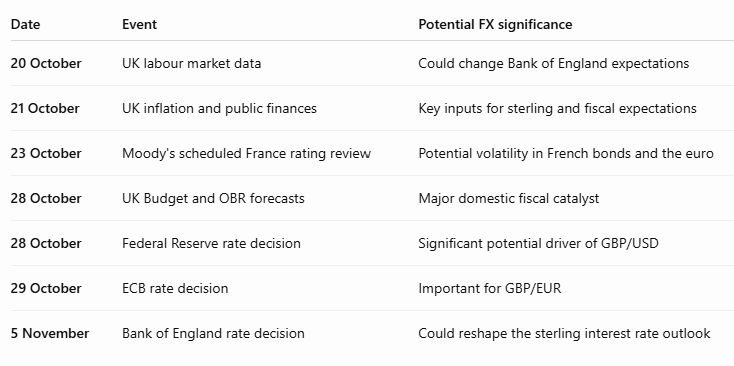
The coincidence of the UK Budget and Federal Reserve announcement on 28 October makes the timing particularly significant.
GBP/USD could experience competing influences from UK fiscal news and US monetary policy within the same trading session.
8. Final outlook: A pivotal period for the pound
Sterling enters the final quarter of 2026 facing a complicated but potentially important turning point.
The UK Budget represents a test of fiscal credibility at a time of elevated government borrowing costs. However, stronger-than-expected domestic growth and renewed expectations of tighter Bank of England policy have provided the pound with support.
Across the Atlantic, persistent US inflation is making the Federal Reserve's next steps increasingly uncertain.
In Europe, France's fiscal difficulties are adding pressure to the euro, raising the possibility that sterling could perform differently against its two most widely traded counterparts.
Our central outlook remains cautiously constructive on sterling's ability to maintain much of its recent resilience, provided the Budget does not materially undermine investor confidence.
Nevertheless, with several major economic and monetary policy decisions approaching, the potential for abrupt movements remains considerable.
For UK businesses, the message is clear: the coming weeks may present both opportunities and risks. Understanding currency exposure and planning future payments will be particularly important as markets respond to the Budget and central bank decisions.